
Low-Carbon Buildings for Newham’s Just Transition
2024 · London, England
Research to disentangle the linked systemic challenges on Newham's housing system: affordability for residents, embodied carbon reduction, and development viability.
Together with London Borough of Newham, Neighbourhood Futures examined why embodied carbon reduction and housing affordability so often exist as competing priorities in London’s housebuilding system. Between 2024 and 2025, our team took a closer look at why that trade-off persists, and where current approaches are getting stuck.
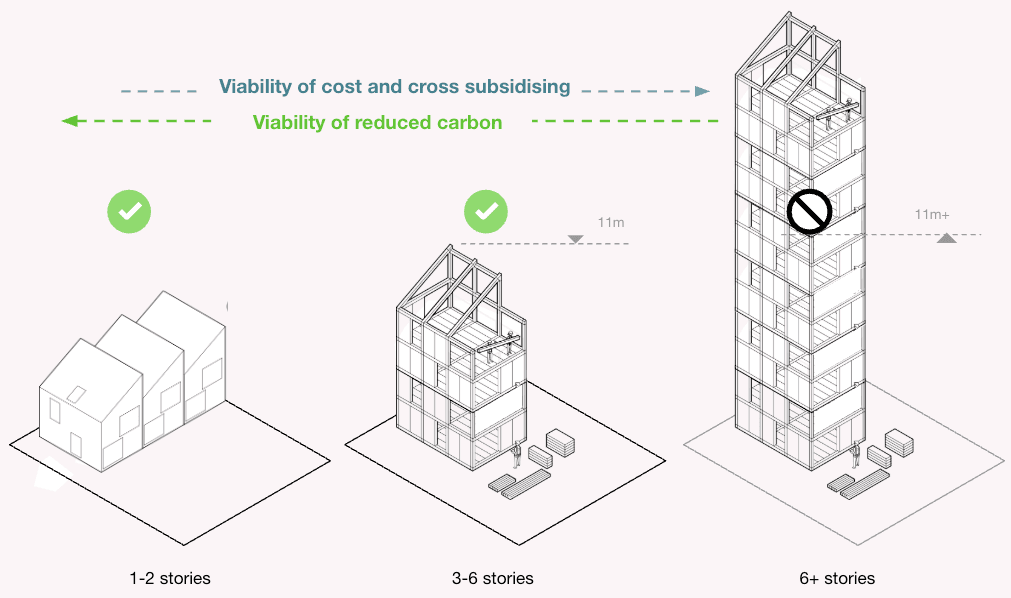
The research reframes affordability across three dimensions: what it costs to build, what it costs to live in, and what it costs the planet. Today, progress toward any one of these tends to push the others backwards. Carbon offsetting slashes the margins that make affordable housing viable. Regulatory restrictions on natural building materials create risk aversion among developers. And ambitious policies — however well-designed — are proving insufficient on their own to shift the underlying system.
Through stakeholder workshops, analysis and mapping, this work focused on Newham as a test case, exploring how borough-scale levers, including Newham's wholly-owned housebuilding company Populo and its new Local Plan, could be reoriented to become a platform for delivering low-carbon, affordable homes at scale. Rather than incremental gains through policy alone, the research points toward deeper interventions: alternative supply chains, procurement process innovation, new development models, and design guidance that embeds carbon reduction from the outset. A demonstrator project in Newham is being explored as a real-world test of whether this vision can be made to work in practice.
Team
- Emma Pfeiffer
- Jack Minchella
- Dan Hill
- Oliver Burgess
Partners
- London Borough of Newham
- Populo Housing
- Carbon Neutral Cities Alliance